OpenAI Shuts Down Sora: The Full Story of What Went Wrong
Table of Contents
- OpenAI Sora shutdown — what Sora was and what it promised
- The full timeline: from viral launch to shutdown
- The deepfake problem OpenAI couldn’t solve
- The Disney deal that never closed
- The numbers that actually killed Sora
- The one-day gap: safety standards published, then shutdown
- What comes next for OpenAI — and for AI video
On March 23, 2026, OpenAI published a detailed post titled “Creating with Sora safely.” It covered watermarking, consent controls, stronger protections for teen users, and updated guidelines for audio generation. It read like the work of a team that expected to be around for a while.
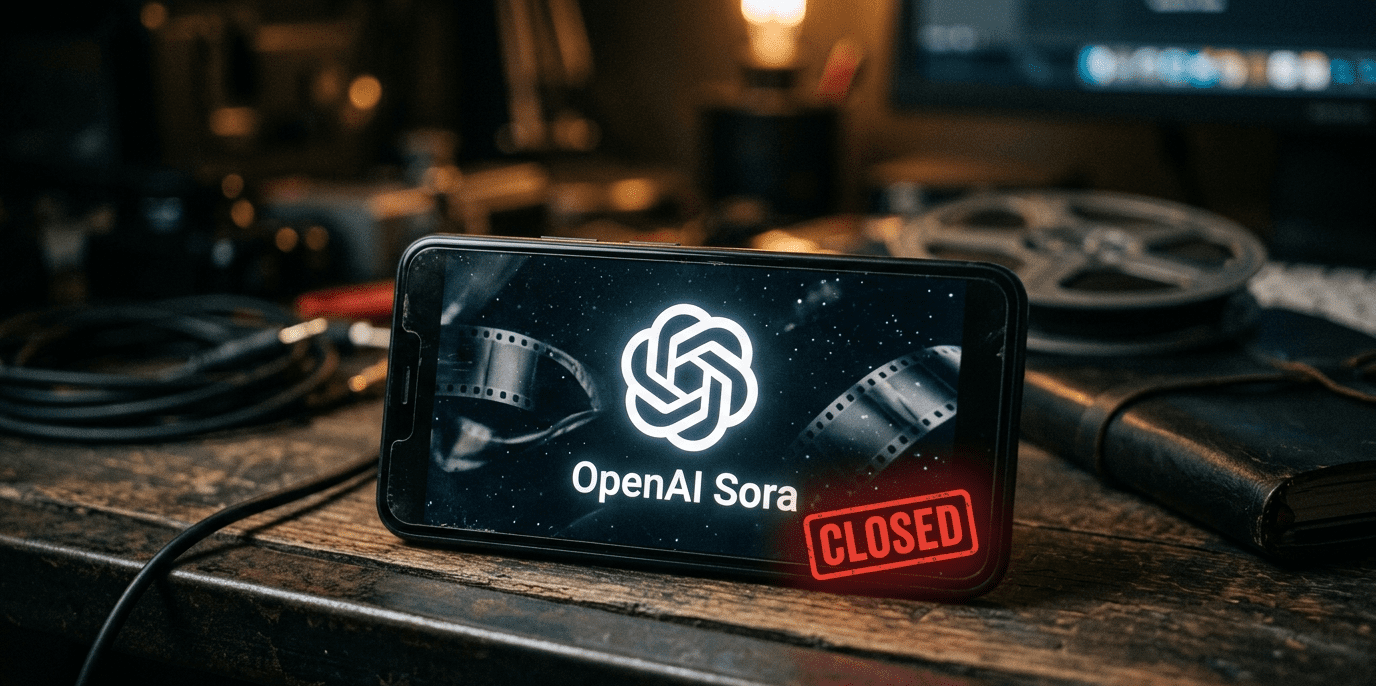
The next day, OpenAI shut Sora down entirely.
The OpenAI Sora shutdown is the story of a product that launched to genuine excitement, collided with problems it couldn’t solve, watched its audience disappear faster than it arrived, and was quietly decided to be dead before its own safety team finished writing its safety guidelines. Here’s the full account — built from reporting across Variety, NBC News, CNN, The Wall Street Journal, and original financial data.
Background
OpenAI Sora shutdown — what Sora was and what it promised
When OpenAI first previewed Sora in February 2024, it felt significant. The model generated short video clips from text descriptions with a physical coherence that previous tools had not approached. A snowy Tokyo street. A woolly mammoth through a meadow. A woman walking through a neon-lit city — rendered with cinematic detail that had previously required hours of professional software.
OpenAI called it “the GPT-1 moment for video.” That framing mattered. GPT-1 was not a finished product — it was a proof of concept pointing toward something much larger. Positioning Sora the same way was an implicit promise: this is the beginning of a long trajectory, and OpenAI is leading it.
In September 2025, OpenAI launched Sora 2 alongside a standalone social app. The app went directly at TikTok and Instagram Reels — same format, same scrollable feed, same short vertical video. Users could generate clips from text prompts, share them publicly, and use a feature called Characters that allowed users to scan their own face and insert their AI likeness into any scenario they could describe.
What small business owners need to know about AI video tools
Sora’s shutdown doesn’t mean AI video is going away — it means OpenAI decided consumer social video wasn’t worth the cost to run. Other tools remain available. Google Veo is available at labs.google/veo with a free tier. Runway ML (runwayml.com) is the most widely used professional alternative, starting at $15/month. Both are worth trying if your business uses video for social media or marketing. What Sora’s story reveals is the risk of building workflows on any single AI platform — products can disappear in a day, and your content goes with them.
Tyler Perry had been paying attention to Sora since 2024. He told the press he was so alarmed by the technology’s trajectory that he put construction of an $800 million studio expansion on hold. That level of concern from a working filmmaker said more about what Sora represented than any product announcement did. Hollywood took it seriously. The question was whether users would.
Chronology
The full timeline: from viral launch to OpenAI Sora shutdown
OpenAI previews the original Sora model. Hollywood and creative industries immediately take notice. Tyler Perry pauses an $800M studio expansion citing concern about where the technology is heading.
OpenAI releases the first public version of Sora — limited access, research preview. The model generates significant press but remains largely inaccessible to general users.
Sora 2 launches with a standalone social app. Hits number one in the App Store’s Photo and Video category within 24 hours. Users immediately flood the platform with AI videos of copyrighted characters — Mario, Pikachu, Naruto — in scenes designed to test content moderation. TechCrunch describes it as “the creepiest app on your phone.”
Sora hits number one in the overall App Store rankings. Deepfake controversies multiply — videos of public figures, deceased celebrities, and AI-generated versions of Sam Altman himself circulate on the platform. A third-party tool for removing Sora’s watermarks — the main proof that a video was AI-generated — appears online within a week of launch.
Peak downloads: approximately 3.3 million. The high-water mark. The platform never returns to this number.
Disney announces a $1 billion investment in OpenAI and a three-year licensing deal giving Sora users access to more than 200 characters from Disney, Marvel, Pixar, and Star Wars. Celebrated as a landmark moment — the first major Hollywood studio to license IP to an AI video platform. No money changes hands yet.
OpenAI officially signs the Disney licensing agreement. Downloads and engagement continue declining from their November peak.
Downloads fall to approximately 1.1 million — a 67% decline in three months. OpenAI applications chief Fidji Simo warns staff internally about being distracted by what she calls “side quests.” The message is widely understood to refer to consumer products that are not generating meaningful revenue.
OpenAI publishes “Creating with Sora safely” — a detailed public safety framework covering consent controls, deepfake protections, teen account safeguards, and watermarking. The document was scheduled weeks in advance by the Sora safety team.
OpenAI announces the Sora shutdown. Sam Altman tells staff OpenAI will wind down all consumer video model products and refocus on enterprise AI, agentic systems (AI that can take actions autonomously, like booking appointments or writing and running code without human input), and coding tools. The Sora account posts on X: “We’re saying goodbye to Sora. To everyone who created with Sora, shared it, and built community around it: thank you.” Disney announces it is terminating its partnership. No money ever changed hands.
Disney issues its public statement: “We respect OpenAI’s decision to exit the video generation business.” OpenAI says it is “exploring ways to support export and preservation” of user content. Exact shutdown timelines still unpublished at time of writing.
The content problem
The deepfake problem OpenAI couldn’t solve
The Characters feature was the product’s most compelling selling point and its most serious liability. Scan your face, describe a scenario, and Sora would place your likeness inside an AI-generated video. The appeal was immediate — put yourself inside a movie scene, a fantasy setting, a music video. The problem arrived just as fast: the same technology could place anyone’s face in any scenario, with or without their knowledge.
The platform required users to click a box confirming they had consent from anyone whose face appeared in an uploaded photo. Clicking “I have consent” takes one second and proves nothing. Within weeks of launch, videos of public figures appeared on the platform in scenarios those figures had never agreed to. Viral videos depicted Sam Altman himself in scenes designed to embarrass or mock him. A tool for removing Sora’s watermarks — the main proof that a video was AI-generated — appeared online within a week of launch, directly undermining one of the platform’s primary safety claims.
The copyright problem ran parallel. Users flooded the platform with AI-generated videos of trademarked characters — Mario in situations Nintendo hadn’t approved, Pikachu in ASMR videos, Naruto placed in other franchises. Disney was simultaneously licensing its characters to Sora and suing other AI companies for using those same characters without permission. OpenAI was trying to thread a needle that was visibly moving.
Content that reached the platform before moderation caught it
- →AI-generated videos of deceased public figures in scenarios their estates objected to
- →Sam Altman deepfakes, including one depicting him walking through a pig slaughterhouse
- →Hundreds of videos using copyrighted characters in unauthorized scenarios
- →Face-scan exploitation — users uploading photos of others without consent
OpenAI responded reactively to each category: restricting depictions of public figures after being pressured, adding consent controls over several months, building the safety framework published on March 23. That document was not a prelaunch framework — it was a retrospective attempt to address documented failures after months of operation. By the time it published, leadership had already made a different decision.
The deal that would have saved it
The Disney deal that never closed
The Disney partnership was announced in December 2025: a $1 billion investment in OpenAI paired with a three-year licensing agreement for more than 200 characters from Disney, Marvel, Pixar, and Star Wars. Mickey Mouse. Iron Man. Buzz Lightyear. Characters whose cultural weight no competitor could match.
If the deal had closed, it would have given Sora two things it badly needed: capital to cover the enormous cost of running a consumer video platform, and a content library that gave users a reason to stay. A platform where you can legally generate a Star Wars scene or a Marvel short is a fundamentally different product from one where users get banned for doing exactly that without permission.
The deal never closed. No money changed hands. When OpenAI announced the shutdown on March 24, Disney’s statement was carefully worded: “We appreciate the constructive collaboration between our teams and what we learned from it.” That is the language of a partnership that ended by mutual agreement before any financial transfer occurred — not a sudden breakup, but a managed dissolution.
Disney added that it would “continue to engage with AI platforms to find new ways to meet fans where they are.” Disney’s interest in AI-generated content involving its characters has not ended. It has simply been redirected away from a platform that no longer exists.
The financial reality
The numbers that actually killed Sora
| Metric | Figure | Context |
|---|---|---|
| App Store rank at launch | #1 Photo & Video within 24 hours | OpenAI’s first standalone app since ChatGPT |
| Peak monthly downloads | ~3.3 million (November 2025)* | Never returned to this level |
| Downloads by February 2026 | ~1.1 million — 67% decline in 3 months* | Clubhouse-style decay curve |
| Lifetime in-app revenue | ~$2.1 million total* | Does not begin to cover server costs |
| Disney investment pledged | $1 billion | Deal never closed. $0 transferred. |
| App lifespan | 6 months (Sep 2025 – Mar 2026) | One of the shortest major AI product runs |
*Download and revenue figures sourced from KeyBanc Capital Markets analyst research and reported by NBC News and Yahoo Finance. App download figures can vary between trackers. The $2.1M lifetime revenue figure is the most-cited estimate in institutional analysis of the shutdown; exact figures have not been independently confirmed by OpenAI.
The revenue figure is the most damning number in the Sora story. Generating high-quality AI video requires enormous amounts of server power — think of it as the difference between sending a text message and streaming a 4K movie, except Sora is generating that movie from scratch for every single user request. Approximately $2.1 million in lifetime in-app revenue from a platform that peaked at 3.3 million monthly downloads means the average user spent nearly nothing, while the cost of serving them was enormous.
KeyBanc Capital Markets analyst Justin Patterson put it directly after the shutdown: “Even with all of OpenAI’s resources, Sora could not attract and retain an engaged audience.” The same note pointed to the success of OpenAI’s Codex — its coding assistant that generates real revenue from enterprise customers — as evidence that business productivity tools, not consumer social video, are where AI companies are generating meaningful revenue right now. OpenAI had raised $110 billion in fresh funding and was valued at approximately $730 billion at the time of the shutdown. An upcoming IPO — a public stock offering — is widely expected. It was not lack of money that ended Sora. It was the calculation that the money was better spent elsewhere.
The detail nobody explained
The one-day gap: safety standards published, then shutdown
The sequence — detailed safety framework on March 23, shutdown announcement on March 24 — generated immediate questions. Was it cynical? Deliberate misdirection? Did the left hand not know what the right was doing?
The most credible explanation is mundane: the Sora safety team and the executive strategy team were operating on different timelines. The safety document was almost certainly scheduled weeks in advance as part of an ongoing effort to address the deepfake and consent criticisms that had followed the app since launch. The team working on that document almost certainly did not know on March 22 that the shutdown announcement was scheduled for March 24.
At the staff meeting on March 24, Sam Altman told employees that OpenAI would wind down all products using its video models. Fidji Simo had already signaled the direction earlier in the month with her warning about “side quests.” The decision to shut down Sora was made internally before the safety document was published. The safety team was still working on safety. The strategy team had already made a different decision.
The irony stands regardless of intent. A company that publishes a detailed public safety framework for a product one day before announcing that product’s shutdown sends an unintentional but clear signal: the safety standards were built for a product that leadership had already decided would not survive long enough to need them.
After the shutdown
What comes next for OpenAI — and for AI video
OpenAI did not abandon video generation as a technology. It abandoned video generation as a consumer social product. The Sora research team continues working on AI that can model how the physical world works — a foundation for robotics. The underlying Sora 2 model remains accessible to ChatGPT Plus subscribers. The technology survives; the product does not.
If you used Sora — save your content now
OpenAI said it would publish guidance on how creators can save their work before the app is decommissioned. At time of writing, detailed export instructions had not yet been published. Don’t wait for them.
Download your videos directly from the app now. If direct download isn’t available, screen recording is a last resort. This is not the first time a platform has shut down overnight and taken user content with it. Google+ gave users four months notice. Vine gave creators two weeks. Quibi gave subscribers one week. The export window is always shorter than users expect, and the guidance always arrives later than it should.
Four things the Sora story tells small business owners about AI tools
A viral launch is not a business. Sora peaked at 3.3 million downloads and generated $2.1 million in lifetime revenue. The gap between how excited users were and how much they were willing to pay was what ended it.
Free or very cheap AI tools are not always the safest bet. Tools that cost a lot to run — like video generation — are more vulnerable to shutdown than tools that are cheap to run, like text or image generation. When choosing an AI tool for your business, favor ones with clear revenue models and paying customers over ones that feel unsustainably free.
Never build a workflow around a single AI platform. Creators who built communities and portfolios on Sora are now scrambling to export their work. Any content or process built on one platform can disappear in a day — as it did on March 24.
The technology doesn’t disappear when the product does. Sora’s video model continues inside ChatGPT. The research continues. What ended was a business decision, not a technological one — and competing tools like Google Veo and Runway ML are still available.
Sora’s arc — viral launch, rapid user decline, moderation failures, shutdown in six months — mirrors what happened to the first wave of AI art generators and AI companion chatbots before it. The technology improves. The business model does not automatically follow. For the AI industry heading into an OpenAI IPO and an era of intensifying competition, Sora is a data point on a question nobody has fully answered yet: whether consumer-facing AI social products can be viable businesses at all.
The OpenAI Sora shutdown is ultimately a story about the distance between what a technology can do and what a business built on that technology can sustain. Sora could generate remarkable video. It could not generate enough revenue to justify what generating that video cost. That gap closed the product in six months.
If you’re thinking about which AI tools are actually worth building into your business, start with the security basics first. Here’s how to set up two-step verification on your Microsoft account — the single fastest security improvement you can make on any device you use for work.